Pool Fences in San Antonio, TX

San Antonio Expert Fence builds pool fences and self-closing gates across San Antonio and the cities around it, to the barrier rules in the pool code the city adopted, for a pool on its way to its final inspection or one that's already in.

  • Self-closing pool gates with the latch where the rules put it
  • Aluminum, wrought iron, vinyl, glass and mesh
  • Gate and latch repairs, not only new fences
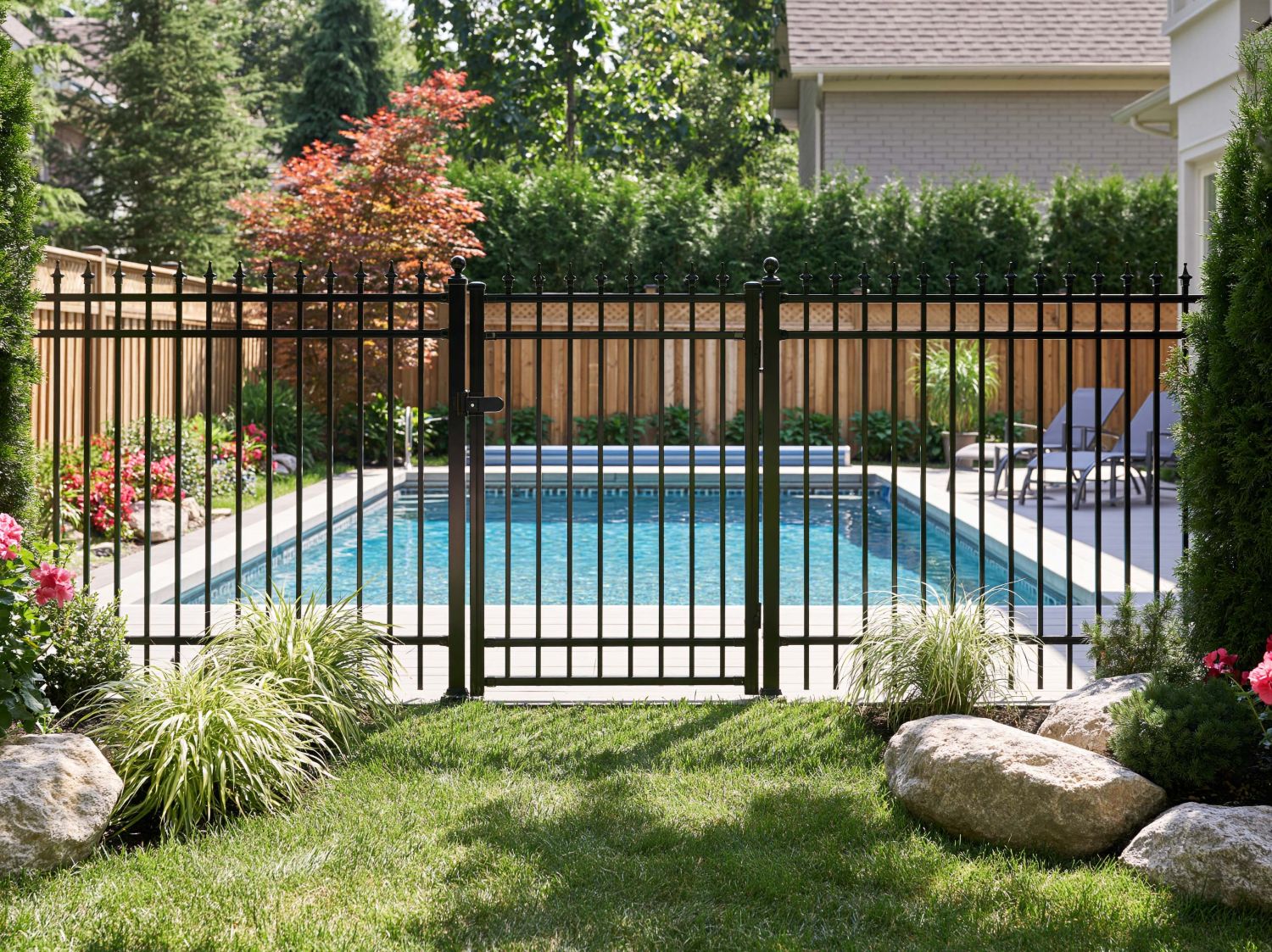
A black aluminum pool fence running along a back yard pool with a pale stone deck and green lawn, and a big live oak behind it

What Makes a Pool Fence Different From the Rest of Your Fence

San Antonio Expert Fence builds pool fences to a different standard than the rest of your fence, because the city holds them to one. An ordinary back yard fence needs no city inspection once it's built. The fence around a new pool does, before the pool can be filled, and we build to those rules from the first post.

Already have a pool, and the fence around it isn't doing its job anymore? That doesn't always mean a whole new fence. Sometimes the trouble is only the gate, which we come back to further down.

Get Your FREE EstimateTell us what you need and we'll get back to you.

How a Pool Fence Fits Into Your Pool Permit

In San Antonio, the fence around a new pool is part of the pool's permit. The permit comes with a site plan, and that plan has to show where the barrier goes, along with any alarms and the self-closing gates. The barrier is then checked at the pool's final inspection, before the pool is filled and used. So the fence isn't something to get around to later.

When a New Pool Is Going In

When the pool permit is applied for, you and the pool's general contractor sign an agreement with the city promising a permanent barrier, built to the pool code and inspected before the pool goes into use. Your pool builder handles the pool. Our part is the fence and the gates, and we work alongside your pool builder so the fence goes in once the deck and the ground around the pool are ready for it, and is planned to be finished ahead of that final inspection.

While the pool is being dug, the city also wants a temporary construction fence at least 3 feet tall around the site, from the time digging starts until the permanent barrier is finished. That's one more reason it helps to have the fence planned early rather than squeezed in at the end.

When the Pool Is Already There

Maybe you've had your pool for years, or you bought a house that came with one. You might want a fence around it for the first time, a better-looking fence than the one that's there, or a replacement for one that's simply worn out. We build those to the same barrier rules the city holds a new pool to.

What the City Checks on a Pool Fence

San Antonio publishes a checklist for pool barriers, drawn from the pool code it adopted. The city calls it a summary rather than the whole code, but it covers the main things the fence itself has to do.

  • At least 48 inches tall, all the way around, measured on the side of the fence away from the pool.
  • A small gap at the bottom. No more than 2 inches where the fence runs over grass or gravel, and no more than 4 inches over concrete.
  • No opening a 4-inch ball could pass through, anywhere in the fence.
  • Chain link and lattice with openings no bigger than 1¾ inches. That means chain link is allowed around a house pool here, as long as the openings are small enough.
  • A stone or masonry wall with no indentations or protrusions beyond normal mortar joints.

Measuring From the Outside

Because the 48 inches is measured on the side away from the pool, the ground outside the fence is what counts. Back yards here often aren't perfectly flat, and if the lawn outside the fence sits higher than the ground inside the fence, the fence has to be tall enough from that higher side. We check the ground all the way around before we settle on panel heights.

Grass, Concrete and the Gap at the Bottom

Most pool fences cross more than one kind of ground, running over lawn in one spot and across the deck or a concrete walk in another. The fence can sit a little higher over concrete than over grass, so we set each stretch to what's under it rather than one height for the whole run.

A Fence That Stays Put

The city defines a pool barrier as permanent, meaning it can't be removed, lifted or moved without a tool. With posts set in concrete that takes care of itself, and it matters most if you're looking at a mesh fence, which we cover below. If a wall of your house makes up one side of the pool area, the doors and windows on that wall have rules of their own, and the questions further down go through them.

From Your First Call to a Finished Pool Fence

  1. Tell Us About Your Pool

    Send the form with a line about your pool, and if it's still being built, where the job stands. We'll call you back and set up a visit to the pool.

  2. We Measure Around the Pool

    We measure all the way around the pool, look at the lawn and deck the fence will cross, and note the doors and windows on the house that face the water.

  3. One Price for the Fence and Gates

    You get one price for the fence, the gates and their closers and latches, and anything you add, and nothing is ordered until you've said yes.

  4. Paperwork and Timing

    We take care of the paperwork that applies to your job, and on a new pool we fit our work into the pool's schedule.

  5. Posts, Panels and Gates Go In

    The posts are set in concrete, then the panels go up and the gates are hung.

  6. Every Gate Tested With You

    We open each gate and let it go, watch it shut and catch, and do it again until it does every time. Then we show you how to adjust it if it ever needs it.

Pool Gates and Latches

The gate is the part of a pool fence that gets used every day, so it's also the part the rules are most specific about. A pool gate has to open outward, away from the pool, and it has to close and latch by itself. You're welcome to add a lock, but it goes alongside the self-latch, never in place of it.

Where the Latch Goes

There are two ways to place the latch, and either one meets the rule:

  • High on the gate, with the release at least 54 inches up from the bottom.
  • On the pool side, at least 3 inches below the top of the gate, as long as the gate and the fence have no opening bigger than ½ inch within 18 inches of the release.

On a 4-foot gate, 54 inches is above the top of the gate, so the latch usually goes on the pool side instead, with the gate and fence kept tight around it. On a taller fence, either option can work, and it comes down to which one you'll find easier to reach every day.

Where the Gate Goes

The best spot for a pool gate is usually wherever you actually walk, most often on the path from the back door to the deck. Because it swings out, the gate needs clear room on the yard side, away from steps, planters and any rise in the lawn. A gate that has to push against the ground or a raised edge won't close on its own, so the ground on the yard side gets checked before the hinge post goes in.

Keeping It Closing

Closers and hinges can need a small adjustment now and then, especially as a new fence settles in. If your gate has stopped pulling itself shut, or the latch doesn't catch the way it used to, that may be something we can fix at the hinge or the latch rather than with a new gate. And when the fence around it is still sound, a tired gate is no reason to replace the whole thing.

A closed black aluminum pool gate set in a black pool fence, seen from the lawn, with the pool and deck beyond it

Choosing a Material for Your Pool Fence

Every material below can be built to the city's pool barrier rules. The choice mostly comes down to how you want the pool to look from the house, how much of a view you want through the fence, and how much upkeep you're comfortable with.

Aluminum and Wrought Iron

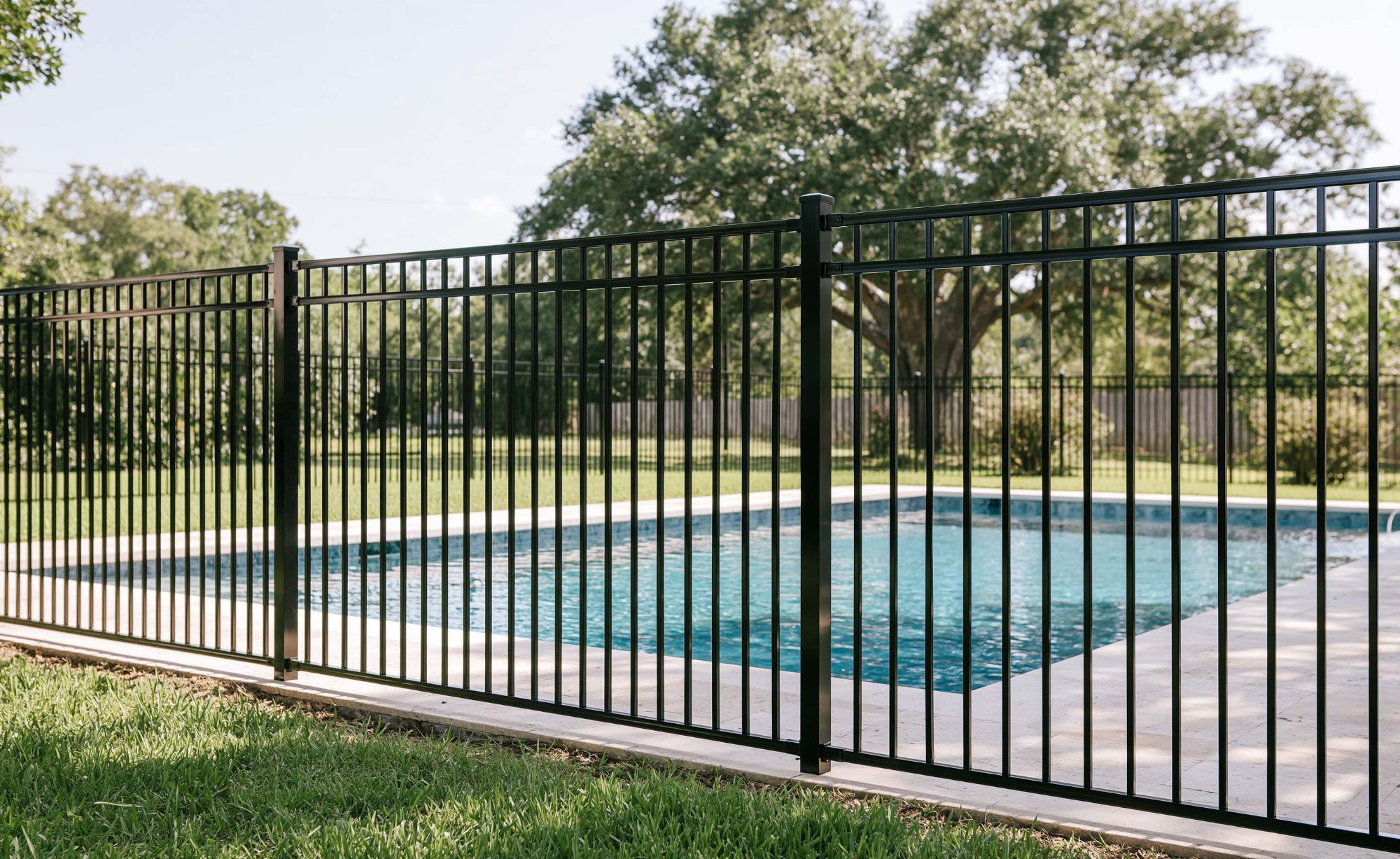
Aluminum is a common choice around pools. It doesn't rust, it's light enough to keep the gates easy to swing, and a black aluminum fence lets you see the water from the house without much getting in the way. Wrought iron gives a similar look with a heavier, more traditional feel. It's strong, and like any iron it needs a touch-up of paint from time to time to keep rust away.

Vinyl and Glass

A vinyl pool fence can give you a solid wall of privacy around the pool and doesn't need painting. Glass goes the other way: clear panels that leave the view of the pool open from every side, and they come framed, semi-frameless or frameless.

Chain Link

If you already have chain link in the yard, or you want a practical fence for a side yard that runs past the pool, chain link can be part of a pool barrier at a house here, with the smaller openings covered above. Black chain link blends into a green yard better than bare metal does.

Mesh Pool Fences

Mesh pool fences are the panels of tight netting on poles that set into sleeves around the deck. The city has its own rules for them: the bottom of the mesh can sit no more than 1 inch above the deck or the ground, it can't be lifted more than 4 inches from it, and a 4-inch ball can't pass under any panel. A mesh fence also has to meet the city's definition of permanent, so a system whose sections lift out by hand isn't the same thing as one that needs a tool to take down. On a new pool, the inspector makes the call at the final inspection, and we'll go over which kind you're looking at before you choose.

A pool at an apartment complex, a condominium or an HOA amenity center goes by a different set of rules under Texas law. Those are on our commercial fencing page.

Pool Fence Prices in San Antonio

These typical Texas installed prices give you a solid starting point. The material you choose and the length of fence it takes to close off the pool usually decide where your price lands, along with how many gates you need.

ItemTypical priceUnit
Aluminum pool fence$15–$34per linear foot installed
Wrought iron pool fence$15–$39per linear foot installed
Vinyl pool fence$15–$39per linear foot installed
Glass pool fence$92–$200per linear foot installed
Self-closing pool gate$190–$490each, installed

Taking out an old fence around the pool, and any stretch that has to cross a deck or step down a slope, is priced at the visit, once we've seen the yard. Try the cost calculator.

Pool Fences in San Antonio: Frequently Asked Questions

How much does a pool fence cost in San Antonio?

It's priced by the foot, with each gate added on. At Texas prices, pool fence jobs typically run about $2,900 to $9,700 installed. By the foot, aluminum, wrought iron and vinyl sit in a similar range, and glass costs the most. Once we've measured around your pool, you'll have a price for your own yard.

Do I have to put a fence around my pool?

For a pool at a house in San Antonio, a barrier is required, and in most yards that means a fence. The one alternative the city allows is a powered safety cover on the pool that meets the ASTM F1346 standard. If you're weighing a cover against a fence, the cover's maker can tell you whether a particular cover qualifies, and we're glad to price the fence so you can compare the two side by side.

Can the wall of my house be one side of the pool fence?

Yes, and plenty of back yards are laid out that way. When it is, the house wall has rules of its own. Any door that opens straight onto the pool area needs an alarm that sounds when the door or its screen opens, or another protection the city approves, such as a door that closes and latches by itself. Ground-floor windows that open and have a sill less than 48 inches above the floor need an alarm too. That's door and alarm work rather than fence work, so it's worth getting it handled alongside the fence.

Can my back yard fence count as part of the pool fence?

It can. The city describes a pool barrier as a fence, a wall, the wall of a building, or a combination of them that completely surrounds the pool. So the fence along your property line can make up part of it, as long as that stretch meets the same pool barrier rules as the rest, with the 48 inches counted on the side away from the pool, and any gate in it swings out, closes and latches on its own. An older fence sometimes falls short at the gate or along the bottom, and we'll tell you what we'd change on yours.

Can I build a taller fence along the back because I have a pool?

Yes. Normally a side or back fence at a San Antonio house stops at 6 feet, but when your back yard has a pool, an above-ground pool or a below-ground hot tub, the side and back fences can go up to 8 feet. The same goes if your neighbor's yard has one and your lot borders theirs. Some people take that chance to add more privacy around the pool while they're putting up the pool fence.

What about an above-ground pool?

An above-ground pool needs a barrier too, but the city allows more than one setup. The barrier can stand on the ground around the pool like any other pool fence, or a barrier can be mounted on top of the pool wall, with no more than 4 inches between the top of the pool and the bottom of the barrier. When the pool wall or a barrier on top of it is doing the job, the ladder or steps either have to be able to be secured, locked or removed, or have a barrier of their own around them. Which setup fits depends on your pool and the yard around it.

Pool Fences Across San Antonio and Nearby Cities

We take pool fence jobs across San Antonio and in the nearby cities below. When your home is in one of those cities, the fence is planned to that city's own rules.

Let's Talk About the Fence Around Your Pool

Whether the pool is still going in or already full, tell us a little about it and we'll set up a time to come see it.

San Antonio Expert Fence is a fence company in San Antonio, Texas, for homes, businesses and HOAs. We repair fences and build new ones, and every job starts with a free visit and a written price.

Each city around San Antonio writes its own fence rules, and we plan every fence to the ones where your home is.

Services

Service Areas

Company

© 2026 San Antonio Expert Fence. Property of Trade Star Local, LLC. All rights reserved. Work performed by qualified contractors in our network.